What do you take trail running? How to build your kit for each outing
Phone, water, an extra layer and a small emergency kit always come along. What you add depends on your outing: a forest loop, a long outing or the mountains. With a first-aid list, medication better left at home, emergency blanket or bivy bag, and calling for help via 112 and satellite.
RouteRadar redactie · Last human review:
Next review:
What do you take trail running? Less than you think for a loop in the woods, and just enough to help yourself out if things go wrong. The basics stay the same: a charged phone, something to drink, a layer against wind or rain and a small emergency kit. What you add depends on how long you'll be out, how far you run from civilisation and what the weather does.
In Belgium you're rarely truly far from a road, but a soaking November evening on the High Fens or a twisted ankle in an Ardennes valley soon feels remote. Pack smart and you run with fewer worries: you don't have to turn back at the first shower, and you know what to do if something goes wrong. That keeps it fun, even when the day turns out differently than planned.
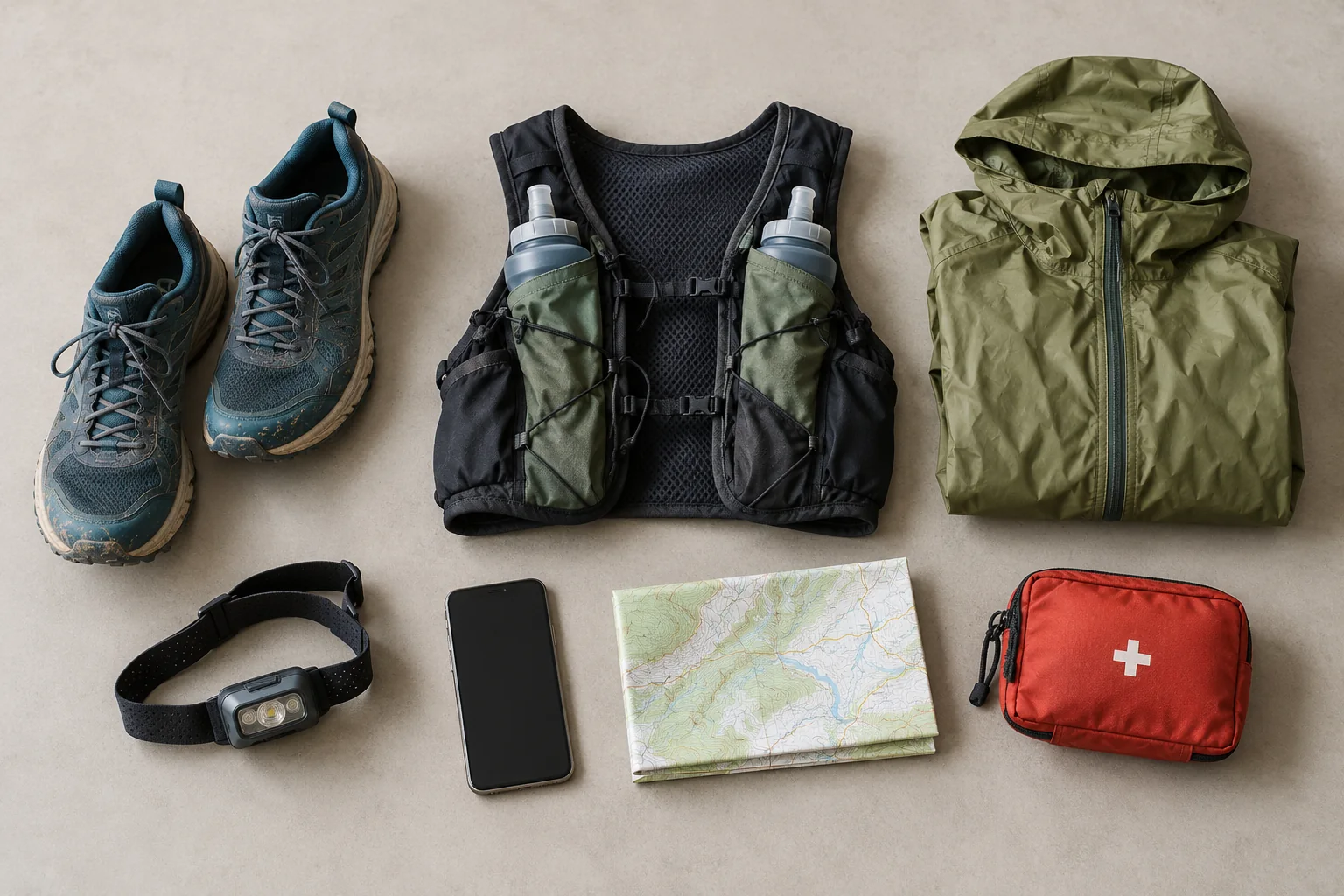
Image credit: RouteRadar
AI-generated illustration.
What do you always take, even on a short loop?
Four things go with you by default, because they solve problems that can pop up at any distance. Your phone is your map, your watch and your line to help, so set off with a full battery. Some water and an extra layer give you slack if you're out longer than planned or the weather turns. A mini emergency kit with a blister plaster, some toilet paper and a bag weighs almost nothing and saves more outings than you'd think.
Tuck some cash into a dry bag too: a few notes take up no room and solve a lot. If you cut an outing short, it pays for a taxi or bus home, or a hot chocolate in the first café to warm up. At some races cash is even mandatory: the rules of the longest Eiger Ultra Trail by UTMB race require every team to carry Swiss francs. So check the rules of your own race as well. [3]
Your shoes are of course part of the basics. On well-kept, flat paths ordinary running shoes often do the job; on rougher terrain, trail shoes give more grip and protection. [1]
What do you add depending on your outing?
How much you carry depends less on the number of kilometres than on one question: how quickly can I reach a road, a house or a café if things go wrong? When planning, look at distance, elevation gain, how technical the path is, how easy it is to find your way, the season, the weather, daylight and local rules. Then choose by situation. [2]
Situation → choice
- Short loop in a forest close to built-up areas, like the Sonian Forest or the Campine heathland → pockets or a waist belt are enough: phone, something to drink and your emergency pouch.
- Longer outing with few places to refill water → a running vest, so water, food, a rain jacket and your emergency gear fit without shifting around.
- Chance you'll get back at dusk, or you're running in winter → headlamp and a warm layer, because standing still in the cold chills you fast.
- Remote route or running alone, like on the High Fens or in deep Ardennes valleys → emergency blanket, whistle, an extra warm layer and a route someone at home knows.
- Mountains or remote outings abroad → bivy bag, more warm clothing, a fuller first-aid kit and a way to call for help without mobile coverage.
- Race → the rules decide: lay the mandatory list next to your own packing list.
How much food and drink do you take?
You plan drinks and food around the time you're out, not the distance. For a shorter loop, a handheld bottle or a waist belt with some water and a small snack is enough. For longer outings, a vest gives room for more water, food, an extra layer and emergency gear. Only count on a cemetery tap or a café if you're sure it's open; if it's closed, take the shorter way back instead of running on with an empty bottle. [1]
On the run, only eat what your stomach already knows. Test a new gel or bar on an ordinary training run, not on your longest outing of the year. Stash your food where you can grab it while running: from a front pocket or waist belt you eat on time, whereas from a backpack you put it off until you're hungry and your pace is already dropping.
How do you find your way, and when do you need a light?
Navigation starts at home: download your route so the map opens without a network, and see where you can cut it short. In a forest with lots of crossing paths, or in the fog on the High Fens, a blue dot on your screen is more reliable than your memory. A path drawn on a map doesn't mean you may use it, though: watch for closures and hunting signs on the spot. [2]
Take a headlamp as soon as your outing could run into dusk, not only when you set off in the dark. Test at home that it stays firmly on your head and that you can switch it on and off with cold, wet hands. Charge it or put in fresh batteries, because an empty lamp won't help you. [1]
What goes in a good first-aid kit?
A handy minimum can be found in the mandatory kit of big trail races. These are rules for that race, not a medical standard, but they show what organisers really think is needed on the course. For the longest Eiger Ultra Trail by UTMB race, every team must carry a kit with an elastic bandage, sterile compresses, disposable gloves, disinfectant wipes and plasters. For the 100 km, the organisation requires every runner to carry a self-adhesive elastic bandage. [3]
Your first-aid pouch, with the Eiger list as a starting point
- Elastic bandage of at least 200 cm × 4 cm.
- Self-adhesive elastic bandage of at least 100 cm × 6 cm. Carrying a bandage doesn't replace knowing first aid: if you can't put weight on it normally, call off the outing and get help.
- 2 sterile compresses of 10 cm × 10 cm.
- 2 disposable vinyl gloves.
- 5 disinfectant wipes or a small bottle of disinfectant spray.
- Ordinary plasters.
- Blister plasters and a bit of tape.
- Your personal medication, for example for allergy or asthma.
- Some toilet paper and an empty bag to carry it back.
- Everything together in a zip freezer bag, so it stays dry.
Blisters are the small problem you'll run into most often, so blister plasters and some tape deserve a permanent spot. Tape up a hot, rubbing spot as soon as you feel it, not once the blister is already there. Your asthma inhaler or allergy medicine goes on every outing, even a short loop. Check the pouch regularly and refill what you used, otherwise you'll find an empty box on the very day you need it. [10]
Toilet paper and a bag belong in the kit, because your bowels don't care about your route. Ideally use the toilet before the start and look for a facility along the way. Carry toilet paper and a sealable waste bag. Don't treat foreign digging guidelines as permission to leave the path or bury waste in a Belgian forest. Follow the local rules and carry used paper back out.
Which medication is better left alone while running?
Don't take ibuprofen or a similar anti-inflammatory to suppress pain during a long run. Prolonged exertion and such drugs can strain your kidneys. In a randomised trial of 89 participants in an 80 km desert stage, 52% of ibuprofen users developed acute kidney injury, against 34% on placebo. That is one trial in extreme conditions, not a figure for every run. [11]
There is another reason to leave painkillers behind: pain is a warning. A painkiller dampens that signal, so you only feel an overload or a starting injury when the damage is already done, and meanwhile you just keep running on it. Pain that makes you limp or changes your stride is a reason to cut the run short, not to take a pill and carry on. If you're in pain or unsure about medication, discuss it beforehand with your doctor or pharmacist, not halfway through an outing. Don't start new or undiscussed self-medication on the way; medication your doctor prescribed, you don't simply stop.
If you get diarrhoea on the way, shorten your outing and put replacing fluids and salts first. Imodium (loperamide) eases the symptoms but doesn't treat the cause and doesn't replace rehydration. Don't use it to finish a long run anyway. Discuss its use beforehand with your doctor or pharmacist; with a fever or blood in your stool, seek medical advice. [12]
Emergency blanket or bivy bag: what's the difference?
An emergency blanket and a bivy bag both keep you warm when you're stuck, but in different ways. An emergency blanket is a thin sheet of shiny foil that you wrap around yourself, like the blankets runners get at a marathon finish. A bivy bag is a cover you crawl into and close up to around your head. Getting an injured runner into such a bag quickly protects them from wind and rain and slows cooling. [9] [10]
| Feature | Emergency blanket | Bivy bag |
|---|---|---|
| What it is | Thin sheet you wrap around yourself | Cover you crawl into and close around your head |
| What it does | Reflects up to about 90% of your body heat; the material blocks wind and water | Blocks wind and water and stays closed; doesn't insulate by itself, so wear warm layers inside |
| Weak points | Doesn't always cover your whole body, has no closure and gets worse if stored for a long time | Heavier and takes up more room |
| Weight and volume | Around 50 to 170 g, fits in your palm | Check weight and packed size on the label |
| When to take it | Short outings where help is close | Remote routes, mountains and bad weather; both together keep you warmest |
| Check yourself | Replace a blanket that has sat in your vest for years | Try whether you fit in with your clothes on |
If you buy an emergency blanket for a race, check the size: for the Eiger Ultra Trail 100 km it must be at least 1.40 m × 2 m, and a whistle is mandatory too. Put that whistle in anyway: six short blasts is the international distress signal, and a whistle carries much further than your voice. [3] [10]
How do you call for help in Belgium?
In an emergency you call 112 and say as clearly as you can where you are. Supported Android phones and iPhones can automatically pass on your location during that call via AML, automatic location for an emergency call. That doesn't replace your own description of the spot: name the path, a recognisable landmark and where you entered the forest. [13]
The 112 BE app is still useful: you pick the emergency service in it and can register extra details beforehand. If you can't speak or hear, the emergency centre can activate the chat function. Install and register the app at home, so you don't have to do it in an emergency. [14]
Also tell someone at home which route you're running and when you plan to be back. If your signal drops in a deep valley, which can happen in the Ardennes, walk to higher or open ground and try again.
When do you need satellite SOS or a satellite communicator?
Recent smartphones and some watches can send an emergency message via satellite when there's no mobile coverage and no wifi. You answer a few short questions, point your device at the sky and your message goes to the emergency services with your location. That only works outdoors, with a clear view of the sky: trees, terrain and buildings can block the connection. Which devices can do it and what to set up beforehand is in the table below. [4] [5] [6]
A satellite communicator goes further than an SOS button. We mention the Garmin inReach because many runners know that name; other brands make similar devices. Such a device works over a satellite network that covers the whole world, even far beyond mobile coverage. You can send and receive messages, share your location and send an SOS to a response centre that is staffed day and night and coordinates the rescue. You do need an active satellite subscription for it. [8]
In Belgium you rarely need such a device. Mobile coverage is wide and help is usually close; a charged phone, the 112 BE app and someone who knows your route do more for your safety. Satellite SOS or a communicator becomes useful in the Alps, the Pyrenees, Scotland or Scandinavia, on long multi-day routes and when you run alone far from roads.
Incident detection on a sports watch is a safety net for your loved ones, not a direct line to 112. With Garmin watches such as the Forerunner 265, after a fall or a call for help the watch sends your name, location and a tracking link to your emergency contacts, but only via a paired phone with data and coverage. The emergency services are not alerted: your contact has to call themselves. So set up your emergency contacts, agree what they do when such a message arrives, and check your own watch's manual to see how it works there. [7]
| System | What it does | Only works if | Set up beforehand |
|---|---|---|---|
| Automatic location (AML) on supported Android phones and iPhones | Can automatically pass on your location during a call to 112; doesn't replace your own description of the spot | Your device supports AML and you can place a 112 call | Charge your phone and always state your position yourself |
| 112 BE app | You pick the emergency service and register extra details beforehand; chat after activation by the emergency centre | You have installed and registered the app | Install the app at home and register your details |
| iPhone 14 or newer: Emergency SOS via satellite | Reaches 112, 100 and 101 in Belgium with a short questionnaire, your location and your Medical ID | There's no mobile coverage and no wifi and you're outside with a clear view of the sky and horizon | iOS 16.4 or newer; free for two years after activation |
| Pixel 9 and newer (not the Pixel 9a): Satellite SOS | After 112 you choose Satellite SOS; replies arrive within a few minutes as messages | Trees, terrain or buildings don't block the connection | Check in the settings that the feature is active |
| Apple Watch Ultra 3 or newer: Emergency SOS via satellite | Also works without an iPhone nearby | There's no mobile coverage and no wifi and you have a clear view of the sky | Fill in your Medical ID and emergency contacts |
| Incident detection on a sports watch (such as on Garmin) | Sends name, location and a tracking link to your emergency contacts; doesn't alert the emergency services | A paired phone has data and coverage | Set up emergency contacts and make agreements |
| Satellite communicator (for example Garmin inReach or similar) | Messages back and forth, location sharing, SOS to a response centre staffed 24/7 | You have a clear view of the sky; worldwide coverage | Active satellite subscription and emergency contacts |
What do you buy first on a tight budget, and what do you check second-hand?
On a tight budget, start with what you already have: your phone, a light jacket and a freezer bag for your first-aid items. After that, buy only what closes a real gap: an emergency blanket and whistle once you run further from home, a headlamp once you run at dusk, a vest only when pockets and a waist belt truly fall short. Pay particular attention to what has to fit you personally, like your shoes and your vest.
Second-hand is a smart choice for vests, backpacks and lamps, if you look carefully. Replace the emergency items from a used vest: an emergency blanket gets worse if stored for a long time, and old plasters often stick badly. A second-hand satellite communicator only works with your own subscription; ask whether the device has been unlinked from the previous owner's account. [8] [9]
Second-hand kit: how to check it
- Test zips, buckles and elastic cords; stretched elastic no longer holds bottles and gear in place.
- Check the seams at the shoulders and armpits for fraying.
- Rinse bottles and the bladder, smell them and check whether the valves leak.
- Charge a lamp and leave it on for an evening to see whether the battery still holds.
- Replace the emergency blanket, plasters and disinfectant wipes that come with a used vest or backpack.
Any questions?
What do you need to take for a trail race?
Whatever that race's rules require, with the sizes and quantities listed in them. Even a short distance can have a list: for the Eiger Ultra Trail by UTMB races in the 20K category, a phone, a cup, 0.5 l of water and a whistle are mandatory. Pack a few days ahead, so you can still top up.
Can I take paracetamol instead of ibuprofen?
Discuss that beforehand with your doctor or pharmacist; they know your health and your other medication. Every painkiller dampens the signal telling you something is wrong. Pain that makes you limp or changes your stride is a reason to slow down or cut the run short, not to take a pill.
Do I need a power bank?
For a short loop usually not, if you set off with a full phone. On long outings, in the cold or if you're navigating the whole time, your battery drains faster; then a small power bank with a cable in a dry bag gives peace of mind. Turn your screen brightness down and close apps you don't need on the way.
How to start this week
Tonight, lay everything you already have on the table and make three piles: always with me, with me on longer outings, still needed. Install and register the 112 BE app, set up the emergency contacts on your phone and watch, and check your first-aid items for completeness, shelf life and intact packaging, and top up what's missing. Then pick a route in RouteRadar, tell someone where you're going and run it. After your outing you'll know exactly what you used, what you missed and what stays home next time.
Sources and evidence
- REI — Essential Trail-Running Gear | Checklist · Source checked on:
- Salomon — How to Start Trail Running? · Source checked on:
- Eiger Ultra Trail by UTMB — Mandatory equipment · Source checked on:
- Apple Support — Use Emergency SOS via satellite on your iPhone · Source checked on:
- Google Pixel Help — Satellite SOS on Pixel · Source checked on:
- Apple Support — Emergency SOS via satellite on Apple Watch Ultra · Source checked on:
- Garmin — Forerunner 265 user manual, Safety and Tracking Features · Source checked on:
- Garmin — What's different about inReach technology? · Source checked on:
- Advnture — Emergency blanket vs bivy (Julia Clarke, 27 February 2025) · Source checked on:
- Mountaineering Scotland — What to pack in your rucksack for emergencies · Source checked on:
- Lipman et al., Emerg Med J 2017 — Ibuprofen versus placebo effect on acute kidney injury in ultramarathons · Source checked on:
- FAGG — Package leaflet Loperamide AB 2 mg (03-2022) · Source checked on:
- EENA - AML Report Card 2023 (Belgian country profile) · Source checked on:
- 112.be - 112 BE mobile application · Source checked on: